
OpenAI's GPT Image 2 plans a scene before it renders it, which is why layouts hold together and text stops melting. None of that changes the part developers actually have to budget for: converting a token metered OpenAI image API pricing invoice into a reliable cost per image before shipping a product.
Understanding GPT Image 2 API pricing is essential before committing an image feature to production. Whether you are budgeting for a low volume prototype or analyzing image generation API pricing across thousands of daily requests, token math dictates your margin.
How GPT Image 2 pricing actually works
Like the rest of OpenAI's API pricing structure, GPT Image 2 does not charge a static fee per output file. It bills dynamically across four separate token rates: $5 per million text input tokens, $8 per million image input tokens, $2 per million cached image input tokens, and $30 per million image output tokens.
Most development teams do not think in raw tokens; they think in generated assets per month. So the metric that actually matters is the effective cost per image once you factor in quality tier, resolution, and expected user retries. If you are comparing this against general AI image API pricing or a video generation API, this token to output conversion challenge is a recurring pattern.
How token pricing is calculated
To calculate your true standard cost per generation on the GPT image API, you must break down the lifecycle of an API payload. A typical request sends a text prompt (text input tokens), optional reference images or masks (image input tokens), and receives a high density matrix of visual tokens back (image output tokens).
Output tokens represent the heaviest component of the invoice. While text input costs a negligible fraction of a cent ($0.000005 per token), generating a high resolution canvas consumes thousands of output visual tokens at the rate of $30 per million tokens. This makes OpenAI image pricing heavily weighted toward the visual complexity and physical dimensions of your requests.
The real cost per image
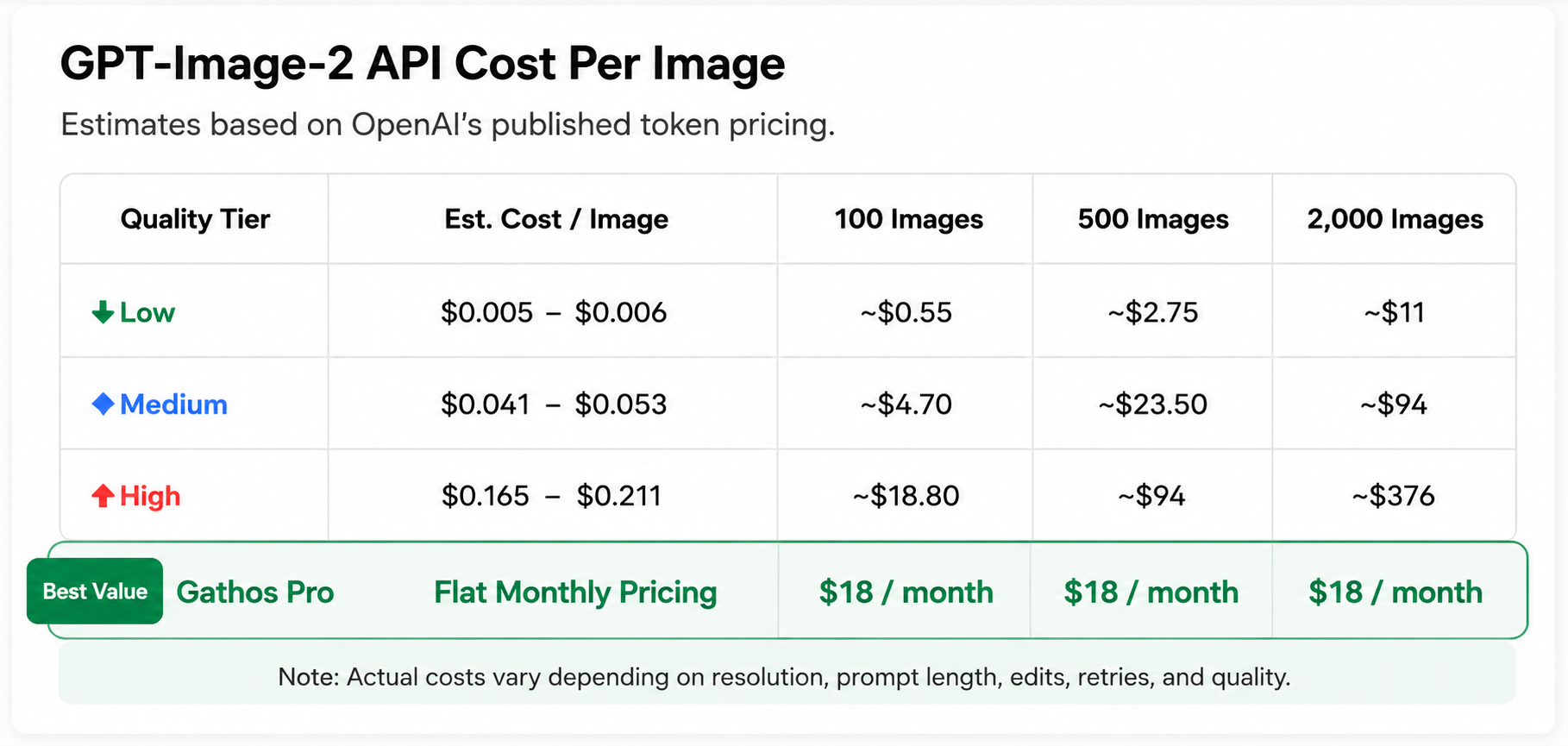
The following figures are estimates calculated using OpenAI's published rates. Keep in mind that exact costs fluctuate depending on prompt detail, canvas resolution, multi turn edits, and retry rates. Use these benchmarks to structure a monthly unit economics model rather than reconcile a final bill.
Low quality pricing
Low quality output runs about $0.005 to $0.006 per image. This represents the cheapest path for draft previews, rapid prompt iteration, or high volume background asset generation where pixel fidelity is secondary to throughput.
Medium quality pricing
Medium quality lands around $0.041 to $0.053 per image. This is the baseline range for general application assets where standard production quality is required without pushing extreme detail density.
High quality pricing
High quality costs $0.165 to $0.211 per image. This tier is necessary for client facing marketing visuals, full bleed hero banners, and intricate artwork, and it is also where usage based monthly totals escalate most rapidly.
Monthly cost examples
| Quality Tier | Cost / Image | 100 Images | 500 Images | 2,000 Images |
|---|---|---|---|---|
| Low Quality | $0.005–$0.006 | ~$0.55 | ~$2.75 | ~$11.00 |
| Medium Quality | $0.041–$0.053 | ~$4.70 | ~$23.50 | ~$94.00 |
| High Quality | $0.165–$0.211 | ~$18.80 | ~$94.00 | ~$376.00 |
| Gathos Pro | Flat Monthly Rate | $18.00/mo | $18.00/mo | $18.00/mo |
Resolution vs. quality pricing breakdown
In addition to quality tiers, physical canvas dimensions directly dictate how visual tokens are allocated during generation. A 1024x1024 square asset requires significantly fewer output tokens than an expanded 1792x1024 landscape banner.
| Dimensions | Quality Tier | Token Estimate | Est. Cost Per Image |
|---|---|---|---|
| 1024 x 1024 | Low | ~180 Tokens | ~$0.0055 |
| 1024 x 1024 | Medium | ~1,500 Tokens | ~$0.0450 |
| 1024 x 1024 | High | ~6,000 Tokens | ~$0.1800 |
| 1792 x 1024 | Medium | ~2,100 Tokens | ~$0.0630 |
| 1792 x 1024 | High | ~7,500 Tokens | ~$0.2250 |
When selecting canvas sizes, developers should remember that wider landscape or taller vertical ratios increase token consumption proportionately, compounding costs at scale.
Real world SaaS cost examples and hidden fees
When modeling business economics for a SaaS application incorporating the GPT Image 2 API, nominal per image figures rarely tell the complete story. Real world end user behavior introduces operational variables that expand total spend.
1. User Retries and Refinements
In actual consumer SaaS environments, users rarely accept their first generated output. On average, users prompt between 2.5 and 4 times before accepting an image. A nominal single generation cost of $0.18 for a high quality asset quickly becomes an actual acquisition cost of $0.45 to $0.72 per completed asset in user workflows.
2. Failed Prompt Attempts & Safety Filters
Automated safety interventions, blocked prompts, or malformed parameter inputs still incur processing overhead or secondary call costs in agentic pipelines. If your system relies on multi stage evaluation scripts to critique and re prompt output, every internal loop bills input and output tokens again.
3. Edits, Masks, and Inpainting
Inpainting or editing an existing canvas requires uploading full context visual tokens (image input tokens) alongside modified prompt parameters. In complex workflows, editing an existing image can cost nearly as much as generating a fresh high resolution file from scratch.
Where usage based billing starts to hurt
At low volume, usage based GPT Image 2 API pricing feels negligible. Generating a few dozen low quality draft thumbnails a month costs pennies, making metered billing ideal for experimental side projects.
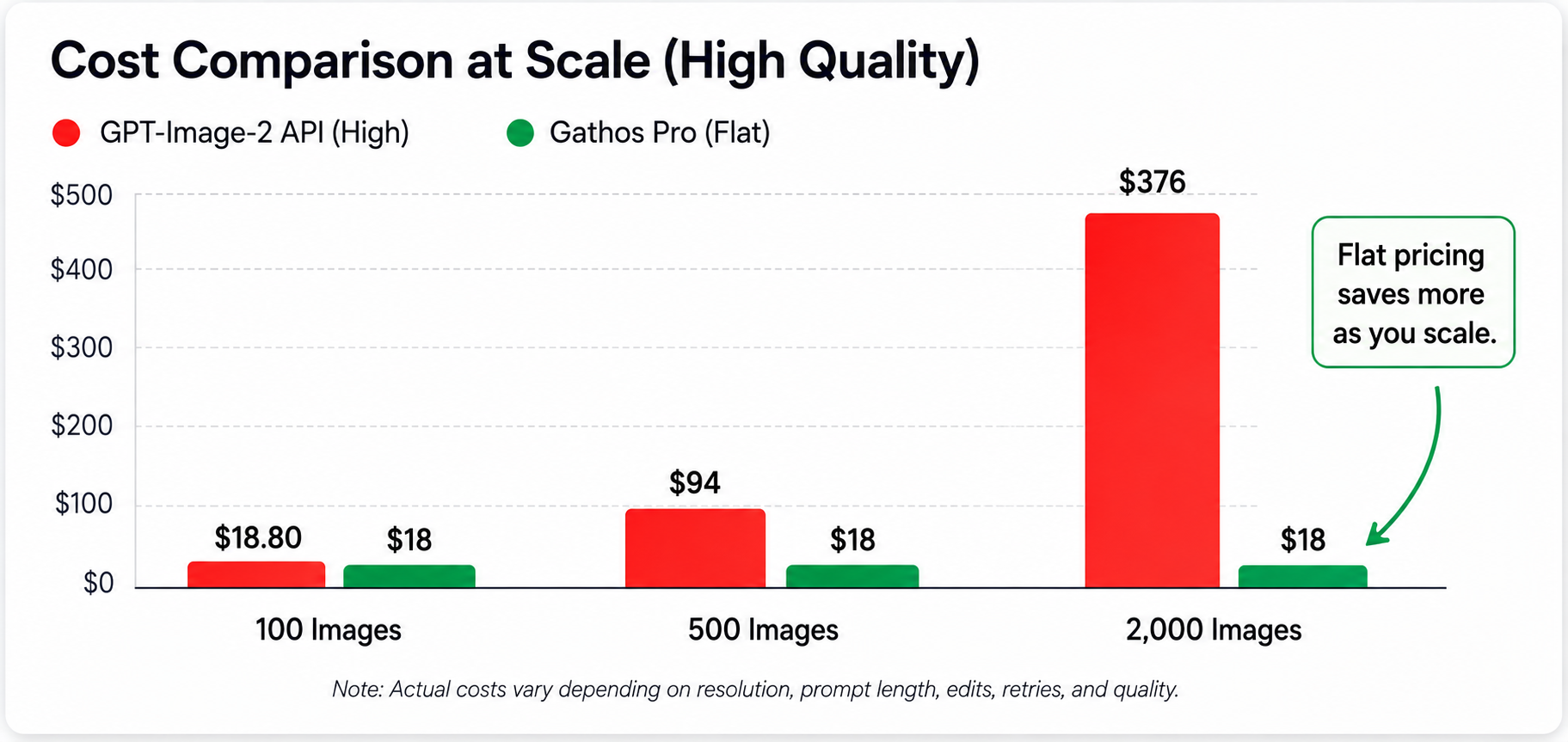
- 500 high quality images per month lands around $94 in raw API usage.
- 2,000 high quality images per month climbs to roughly $376 in usage fees.
- Every user retry, image mask edit, and resolution upgrade adds directly to your monthly invoice.
For a production SaaS product or an AI agent built on an image API generating images continuously, token volatility becomes a financial risk. Infrastructure expenses start scaling linearly with active usage, creating unpredictable unit economics that strain operating margins.
ChatGPT Plus is a different product
A frequent point of confusion among developers is assuming a ChatGPT Plus subscription includes backend developer API access. ChatGPT Plus costs $20 per month and includes consumer image generation inside the conversational interface for manual personal use.
In contrast, the GPT Image 2 API is an independent programmatic tool meant for software applications, backend scripts, and autonomous AI agents. If your application issues automated HTTP requests to build features, standard token based API meters apply regardless of any individual ChatGPT Plus subscription.
Flat rate pricing, in practice
Gathos operates on a flat monthly membership model rather than per token metered usage. This keeps integration straightforward and cost forecasting perfectly predictable. You can view full plan tiers directly on the Gathos pricing page.
curl -X POST https://api.gathos.com/api/v1/image-generation \
  -H "Authorization: Bearer $GATHOS_API_KEY" \
  -H "Content-Type: application/json" \
  -d '{
    "prompt": "Editorial product photo, soft studio light",
    "style": "photorealistic",
    "resolution": "1024x1024"
  }'
Under a flat $18 per month rate, generating 100 images or 2,000 images costs identical money because your tier is not metered per API request. To be transparent: flat rate subscriptions are clearly superior once production volume passes a few hundred high quality generations monthly, whereas metered usage based billing is more economical if you only issue a dozen calls per year.
GPT Image 2 vs. Gathos Comparison
Search engines and technical teams both value clear structural comparison tables when evaluating developer tooling. Here is how the two operational frameworks compare side by side:
| Feature | GPT Image 2 | Gathos |
|---|---|---|
| Pricing Model | Usage based (Token) | Flat Rate Monthly |
| Monthly Base Cost | Variable ($0 + usage) | $18 / month |
| Billing Metric | Input / Output Tokens | Fixed Subscription Tier |
| Image API Access | Yes | Yes |
| Voice / TTS API | No (Separate endpoint) | Yes (Included) |
| Video API | No (Separate endpoint) | Yes (Included) |
Who should choose which provider?
Who should choose GPT Image 2?
GPT Image 2 is a strong choice for specific development conditions:
- Early Stage Startups & Prototypes: When building an unproven MVP that may only generate 50 images total during testing.
- Low Volume Applications: Workflows that trigger image generation rarely, keeping total monthly spend well under $10.
- Granular Token Tuning: Teams that want precise control over text input versus image cached input token optimization.
Who should choose Gathos?
Gathos is optimized for scaling production infrastructure and agentic workflows:
- Autonomous AI Agents: Autonomous loops that continuously generate images without human cost oversight.
- Commercial SaaS Applications: User facing applications requiring fixed customer acquisition costs and predictable margins.
- High Volume Generation: Platforms generating hundreds or thousands of high fidelity visual assets monthly.
- All in One Media Stacks: Engineering teams requiring simultaneous image, voice, and video generation endpoints in a single stack.
Evaluating API alternatives and billing models
When selecting an image generation API pricing strategy, developers generally choose between two primary billing philosophies:
1. Token and Usage Based Billing
Offered by primary foundation model providers like OpenAI. This model aligns cost directly with micro consumption, making startup costs virtually zero. However, it exposes growing companies to exponential bill expansion when usage scales unexpectedly.
2. Subscription and Flat Rate Billing
Offered by platform aggregators and infrastructure providers like Gathos. By capping monthly API costs to a predictable flat rate, software businesses can offer unlimited or high tier usage caps to end users without incurring variable vendor fees.
What to watch out for
GPT Image 2's planning step provides clear improvements for layout structure and text rendering, though developers occasionally observe differences in prompt compliance between raw API payloads and the ChatGPT consumer interface. Test your prompts extensively via code before scaling production. Furthermore, note that OpenAI officially removed legacy DALL E 2 and DALL E 3 endpoints from its API on May 12, 2026, meaning all legacy integration comparisons are now purely historical.
Generate unlimited AI images with predictable pricing →
Swap metered per token billing for a flat monthly plan without rearchitecting your application integration. Explore our unified image, video, and voice APIs.
Start free →Frequently asked questions
What is GPT Image 2?
GPT Image 2 is OpenAI's flagship image generation model released for programmatic API access. It features advanced multi turn scene layout, crisp text rendering capabilities, and variable token based pricing for developers building visual workflows.
Is GPT Image 2 available through the OpenAI API?
Yes, GPT Image 2 is directly available through the official OpenAI API endpoint. Developers can access it programmatically using SDKs or standard HTTP POST requests billed on usage based on input and output image tokens.
How much does the GPT Image 2 API actually cost per image?
Based on OpenAI's published token rates, low quality images run about $0.005 to $0.006 each, medium quality about $0.041 to $0.053, and high quality about $0.165 to $0.211. At 2,000 high quality images a month, that is roughly $376.
Is GPT Image 2 the same as image generation in ChatGPT Plus?
No. ChatGPT Plus ($20/month) includes image generation for personal manual use inside the chat interface. The GPT Image 2 API is billed separately, by token, and is meant for developers building features into programmatic applications or agents.
Is GPT Image 2 cheaper than DALL E?
DALL E 2 and DALL E 3 were retired from OpenAI's API on May 12, 2026, so there is no longer a direct API comparison to make. GPT Image 2 is the current flagship, sitting above the cheaper GPT Image 1 Mini tier.
Does GPT Image 2 pricing depend on resolution?
Yes. Resolution and quality tier both change how many image tokens a generation consumes, so a larger or higher quality output costs more even with an identical prompt string.
When does flat rate pricing actually beat usage based pricing?
Once you are generating a few hundred high quality images a month or more consistently. Below that threshold, usage based billing is often cheaper since you only pay for exact tokens consumed.
Is GPT Image 2 good for production workloads?
It works well at moderate volume, but token based billing means costs scale directly with usage, which makes long term budgeting harder for continuous, high volume, or agent driven production pipelines.
Try Gathos for 7 days, free.
Image, TTS, and Creator video APIs in one agent friendly stack. No credit card required to get started.