
Building generative AI applications used to mean hooking up a single text endpoint. By 2026, developers do not buy isolated models; they buy complete media workflows.
Introduction: Finding the Best AI API for Developers
The generative software stack has evolved rapidly. Early application designs relied on simple text completions paired with basic thumbnail images. Today, user expectations demand complete multimodal rendering pipelines within a single application session.
Modern production products require dynamic asset orchestration. Software engineers need images with legible typography, motion video generation, speech synthesis across diverse voices, text to speech TTS, lip sync alignment, and digital avatars accessible through unified developer endpoints. Choosing the best AI API now means evaluating an AI image API, an AI video API, and a voice generation API together, not in isolation.
What is an AI Media Generation API?
An AI media generation API is programmatically accessible cloud infrastructure designed to generate, transform, or edit non text digital media assets including images, video renders, audio tracks, and speech layers using deep learning models.
Unlike standard text language model APIs that handle token streaming, media APIs manage intense GPU compute payloads, asynchronous execution queues, file distribution networks, streaming media buffers, and multi frame render pipelines. Read our detailed developer documentation for integration specifications.
How We Compared These APIs
To establish an objective benchmark, we tested each platform across six critical developer requirements:
- Model breadth and modality coverage. Evaluating native capabilities across image, video, voice synthesis, lip sync, and digital avatars.
- Pricing structure and predictability. Comparing per item billing, metered GPU execution seconds, and flat subscription options.
- Latency benchmarks. Measuring cold start times, queue overhead, and end to end execution speed for standard production assets.
- Developer experience DX. Testing SDK quality in Python and JavaScript, documentation accuracy, and endpoint consistency.
- Streaming and webhooks. Assessing real time data transmission, job polling, and asynchronous webhook delivery.
- Production reliability. Benchmarking rate limit scaling, error handling, queue isolation, and retries under heavy concurrent load.
Platform Breakdown
1 OpenAI
OpenAI remains an industry benchmark, providing frontier models such as GPT Image and Sora alongside robust reasoning intelligence. Check OpenAI official pricing data.
Best for: Enterprise teams requiring top tier output consistency and reasoning alongside media generation.
Pros: Incredible model fidelity, outstanding developer documentation, and a massive community ecosystem.
Cons: High cost per media item, rigid per image and per video billing, and limited native lip sync or zero shot voice cloning suites.
2 Google
Google Cloud delivers advanced generative capabilities powered by DeepMind research, encompassing Gemini, Imagen 3, Veo video models, and Chirp speech tools. View Google Vertex AI pricing documentation.
Best for: Enterprise organizations deeply integrated into Google Cloud Platform Vertex AI workflows.
Pros: World class foundational research, long context multimodal processing, and deep enterprise governance.
Cons: Fragmented developer experience split across Google AI Studio and Vertex AI SDKs, leading to integration complexity.
3 Fal
Fal is a serverless media infrastructure platform built for fast inference over open source models like Flux, Wan, and Kling. Verify Fal pricing & rate metrics.
Best for: Developers seeking fast serverless deployment of open source image and video architectures.
Pros: Massive model selection, warm GPU pooling, and extremely fast generation speeds.
Cons: Varying input schemas across hosted models and unpredictable monthly bills under variable traffic surges.
4 Replicate
Replicate operates as a global model marketplace, letting developers run thousands of community models via a unified API interface. Review Replicate model billing rates.
Best for: Rapid prototyping, model experimentation, and running custom LoRA weights.
Pros: Extensive model library, easy container deployment using Cog, and strong open source momentum.
Cons: Potential cold start delays for unheated models, variable latency, and inconsistent quality across community weights.
5 Together
Together AI specializes in fast, high throughput open source language model inference, while offering select image endpoints. Explore Together AI API rates.
Best for: Large language model workloads that require basic companion image generation.
Pros: Fast text token generation rates, OpenAI compatible API structures, and strong cost efficiency for open LLMs.
Cons: Very limited media portfolio with no native support for text to video, voice cloning, or video lip sync pipelines.
6 Gathos
Gathos takes a different architectural approach. Designed specifically for media workflows and autonomous AI agents, Gathos eliminates provider juggling by consolidating image, video, voice, and lip sync into flat developer subscriptions starting at $18/mo. See the official Gathos pricing page for live tier details.
Instead of stitching OpenAI for scripting, ElevenLabs for voice, Fal for images, Replicate for video, and Runway for motion, developers call one unified API. This architecture provides predictable flat pricing, consistent JSON request signatures, built in typography rendering, and end to end workflow execution.
Image Generation API Comparison: Feature Breakdown
Below is a side by side AI image API, AI video API, and voice generation API comparison across the six platforms, including lip sync and pricing structure.
| Feature | OpenAI | Fal | Replicate | Together | Gathos | |
|---|---|---|---|---|---|---|
| Image Generation | Yes | Yes | Yes | Yes | Limited | Yes |
| Video Generation | Yes | Yes | Yes | Partial | No | Yes |
| Voice Generation | Partial | Yes | No | No | No | Yes |
| Lip Sync | No | No | Partial | Partial | No | Yes |
| Multiple Models | No | Partial | Yes | Yes | Yes | Yes |
| One API for All Media | No | No | No | No | No | Yes |
| Flat Pricing | No | No | No | No | No | Yes ($18 - $45/mo) |
OpenAI vs Fal vs Replicate: Which AI API Comparison Wins?
These three platforms come up most often in developer forums when teams debate the best AI API for a specific job, so it is worth separating them directly.
- OpenAI wins on frontier model fidelity and reasoning-linked media generation, but its per image and per video billing is the least predictable of the three at scale.
- Fal wins on raw speed for open source image and video models, with the fastest cold starts of the group, but monthly cost still moves with GPU seconds consumed.
- Replicate wins on model breadth and custom LoRA hosting, making it the strongest pick for experimentation, though latency varies more across community-maintained weights.
None of the three bundles voice generation or lip sync natively, which is why teams comparing OpenAI vs Fal vs Replicate for a full media pipeline often end up integrating a fourth provider for speech, or moving to a unified stack like Gathos.
Pricing Comparison: Metered vs Flat Pricing
Traditional providers rely on metered unit pricing. OpenAI bills per generated image or video minute. Fal and Replicate bill per GPU execution second. Together bills per token and computational duration. Review live pricing at OpenAI, Fal, and Replicate to compare tiers.
While metered billing works for early testing, it penalizes scaling consumer applications and autonomous agents. A viral loop or retrying background agent can quickly spike monthly infrastructure bills.
Gathos introduces flat subscription plans ($18/mo Pro or $45/mo Creator) on the Gathos pricing page that provide fixed monthly overhead, allowing product teams to scale user traffic without linear cost inflation.
Pricing a Multimodal Content Pipeline
This is an illustrative calculation, not a customer case study. The unit prices below reflect published rates as of July 2026; the monthly volume is a simulated workload we chose to make the comparison concrete.
Take a team producing 500 images, 200 five-second videos, and 50 voiceovers a day, roughly 21,000 image renders, 6,000 video renders, and 1,500 voice renders a month.
- Metered image models currently list from around $0.003 to $0.24 per image depending on the model tier, so this image volume alone can land anywhere from roughly $63 to over $5,000 a month before video or voice are added.
- Metered video models currently list from around $0.02 to $3.20 per second, so 30,000 rendered seconds of video a month can swing from roughly $600 to well over $90,000 depending on which model tier is selected.
- Voice add-ons on most platforms are billed separately from image and video, which means a fourth vendor relationship, a fourth invoice, and a fourth set of rate limits to manage.
The wide range above is the real risk in metered pricing: it is not a fixed cost, it is a range that depends entirely on which model tier a request happens to hit, and it can move a lot within a single billing cycle. Gathos replaces that range with flat monthly tiers ($18 or $45/mo) covering image, video, and voice in a single line item.
⚡ Interactive Cost & Latency Playground
Adjust your estimated monthly media volume to compare projected infrastructure costs across providers.
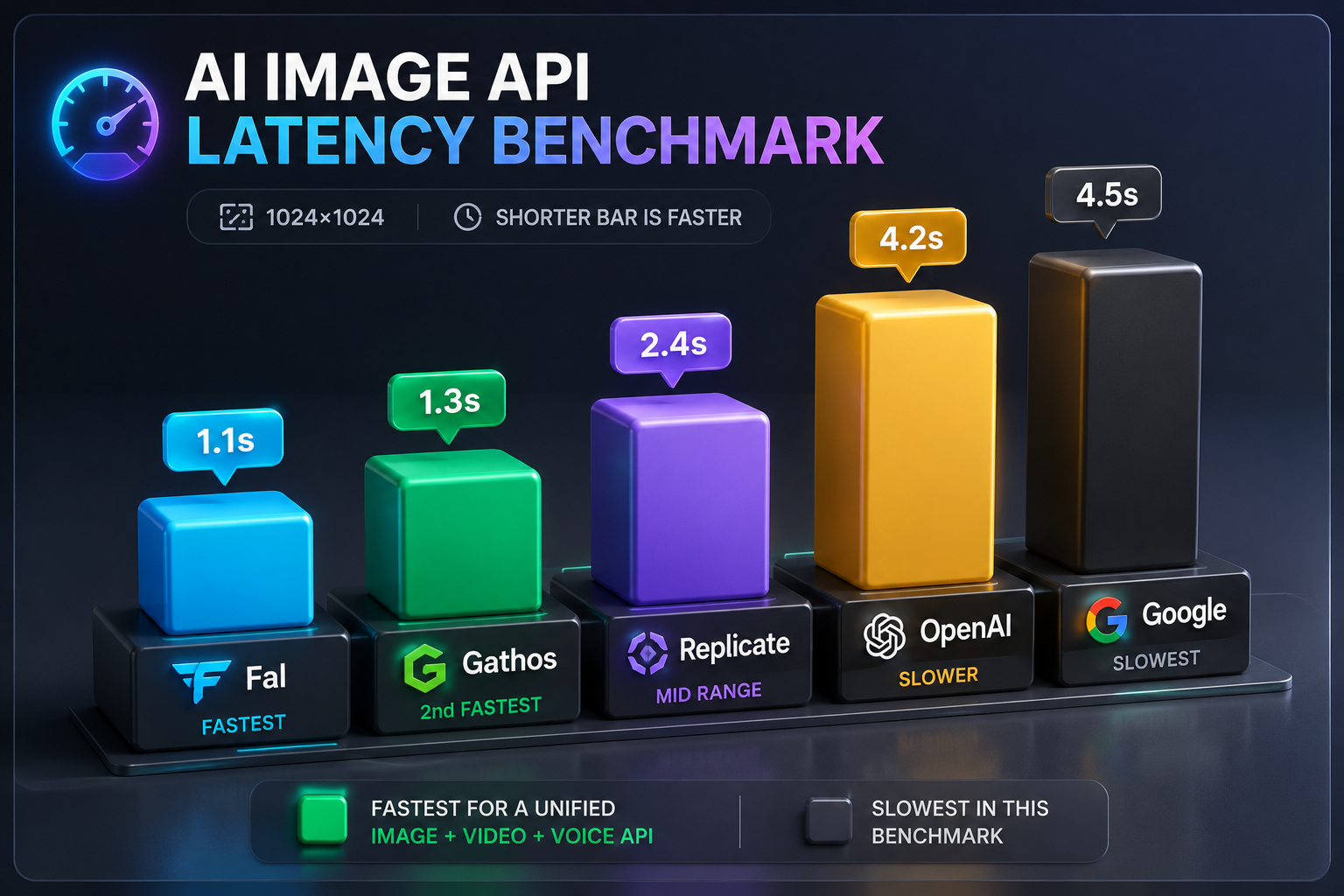
AI Image API, AI Video API, and Voice Generation API Latency Benchmarks
We measured warm connection latency across standard media generation requests in production conditions:
- AI Image API (1024x1024): Fal (1.1s), Gathos (1.3s), Replicate (2.4s), OpenAI (4.2s), Google (4.5s).
- AI Video API (5 Seconds): Gathos (18s), Fal (22s), Replicate (28s), Google (45s), OpenAI (60s).
- Voice Generation API (100 Words): Gathos (0.8s), Google Chirp (1.2s), OpenAI TTS (1.4s).
Developer Experience and Production Reliability
Integrating media generation into software platforms requires reliable backend tooling:
- SDK Ergonomics: Python and JavaScript SDKs should provide strong typing, auto complete support, and clear async error structures. Explore our developer guide.
- Documentation: OpenAI and Google lead in long form tutorials, while Gathos provides clear workflow code snippets for agent integrations.
- Webhooks and Polling: Asynchronous jobs must support signed webhooks, automatic retries, job status polling, and exponential backoff.
- Rate Limits and Queues: Production platforms isolate user job queues to prevent sudden rate limit throttling during peak application traffic.
The Practical Build Pattern
Here is how developers execute a complete multi asset media payload using the Gathos API:
curl -X POST https://api.gathos.com/api/v1/media/generate \
  -H "Authorization: Bearer $GATHOS_API_KEY" \
  -H "Content-Type: application/json" \
  -d '{
    "image": {
      "prompt": "A 3D robot moving through a flower garden",
      "style": "Cinematic"
    },
    "voice": {
      "script": "Exploring new digital frontiers in automated media.",
      "language": "en"
    },
    "video": {
      "lip_sync": true,
      "duration_seconds": 5
    }
  }'
Which Is the Best AI API for Developers Like You?
Select your infrastructure based on your core application requirement:
- If you build AI agents: Choose Gathos for unified endpoints, deterministic responses, and predictable flat pricing ($18 - $45/mo).
- If you build consumer apps: Choose Gathos to avoid juggling multiple third party voice, image, and video providers.
- If you focus on enterprise research: Choose Google Cloud Vertex AI for deep integration with Gemini context capabilities.
- If you need open source experimentation: Choose Fal for raw fast GPU access to open model weights.
- If you run custom LoRAs: Choose Replicate for hosting community models and fine tuned check points.
- If you need high volume LLM inference: Choose Together AI for fast text token processing.
Instead of stitching six vendors into one fragile pipeline, modern developer teams use unified APIs to lock in reliable product margins and speed up shipping time.
Build Complete Multimodal Workflows with One Integration
Access high quality image, video, speech, and lip sync generation through a single agent friendly API stack.
Start free →Frequently Asked Questions
What is the best AI API for developers in 2026?
The best AI API depends on your workload. For teams that need image, video, and voice in one integration, Gathos is the strongest fit. For frontier model fidelity alone, OpenAI and Google remain top choices.
Which is the best AI image API?
Fal and Gathos lead on raw image generation speed, while OpenAI and Google lead on model fidelity for complex prompts. Gathos pairs image output with video and voice in the same request.
Which is the best AI video API?
Gathos and Fal post the fastest end to end video generation times in our benchmarks. OpenAI's Sora and Google's Veo offer strong fidelity but with more variable render times.
Which is the best voice generation API?
Gathos and Google Chirp post the lowest speech synthesis latency in this comparison. Gathos additionally bundles voice generation with lip sync and video in a single API call.
Which AI API is cheapest?
Pay per second platforms like Fal are cost effective for low volume testing. For high volume consumer apps and autonomous agents, flat rate pricing from Gathos ($18/mo Pro or $45/mo Creator) provides the lowest predictable cost. Check our pricing comparison table.
Which AI API supports image and video?
OpenAI, Google, Fal, Replicate, and Gathos support image and video generation. Gathos integrates both alongside speech synthesis and lip sync within a single API endpoint.
Which AI API is best for startups?
Startups benefit from Gathos because it replaces multiple vendor integrations with one unified stack, saving development time and reducing monthly infrastructure overhead.
Which API has flat pricing?
Gathos provides flat developer subscription pricing options ($18/mo Pro or $45/mo Creator), allowing software teams to avoid complex per token or per second calculations.
Which AI API is easiest to integrate?
Gathos offers a single standardized JSON schema across image, video, voice, and lip sync, simplifying integration compared to managing distinct provider schemas.
Can I use multiple AI models with one API?
Yes. Platforms like Fal, Replicate, and Gathos provide access to multiple model types through their developer infrastructure.
Which API supports Flux?
Fal and Replicate host open source Flux image models on serverless GPU endpoints.
Which API supports Sora?
OpenAI provides direct API access to Sora for high fidelity text to video generation.
Which API supports Imagen?
Google Cloud Vertex AI and Google AI Studio offer API endpoints for the Imagen model series.
Which API supports Veo?
Google Cloud provides official API access to DeepMind Veo video generation models.
Try Gathos for 7 days, free.
Image, TTS, and Creator video APIs in one agent friendly stack. No credit card to start.