Picking an AI image or TTS API in 2026 is harder than it should be. The marketing pages all say the same thing; the pricing pages all hide their per-call meters; the developer-experience differences only become visible after you have already integrated. This guide is the one we wish existed when we were evaluating.
Key takeaways
- 01Per-image pricing became uneconomic for production in 2026; flat-rate is now the default for most workloads above ~500 calls a month.
- 02Image splits into four that matter (Midjourney, Nano Banana Pro, Fal.ai, Gathos) plus specialists for typography, SVG, and budget.
- 03TTS comes down to three: ElevenLabs for English quality, PlayHT for multilingual, Gathos for long-tail languages and bulk volume.
- 04Zero-shot voice cloning solved multilingual: a 30-second sample at inference replaced hiring a voice actor per language.
- 05Most teams run a hybrid stack: a premium provider for the 5% where quality matters, flat-rate for the bulk.
Quick Answer
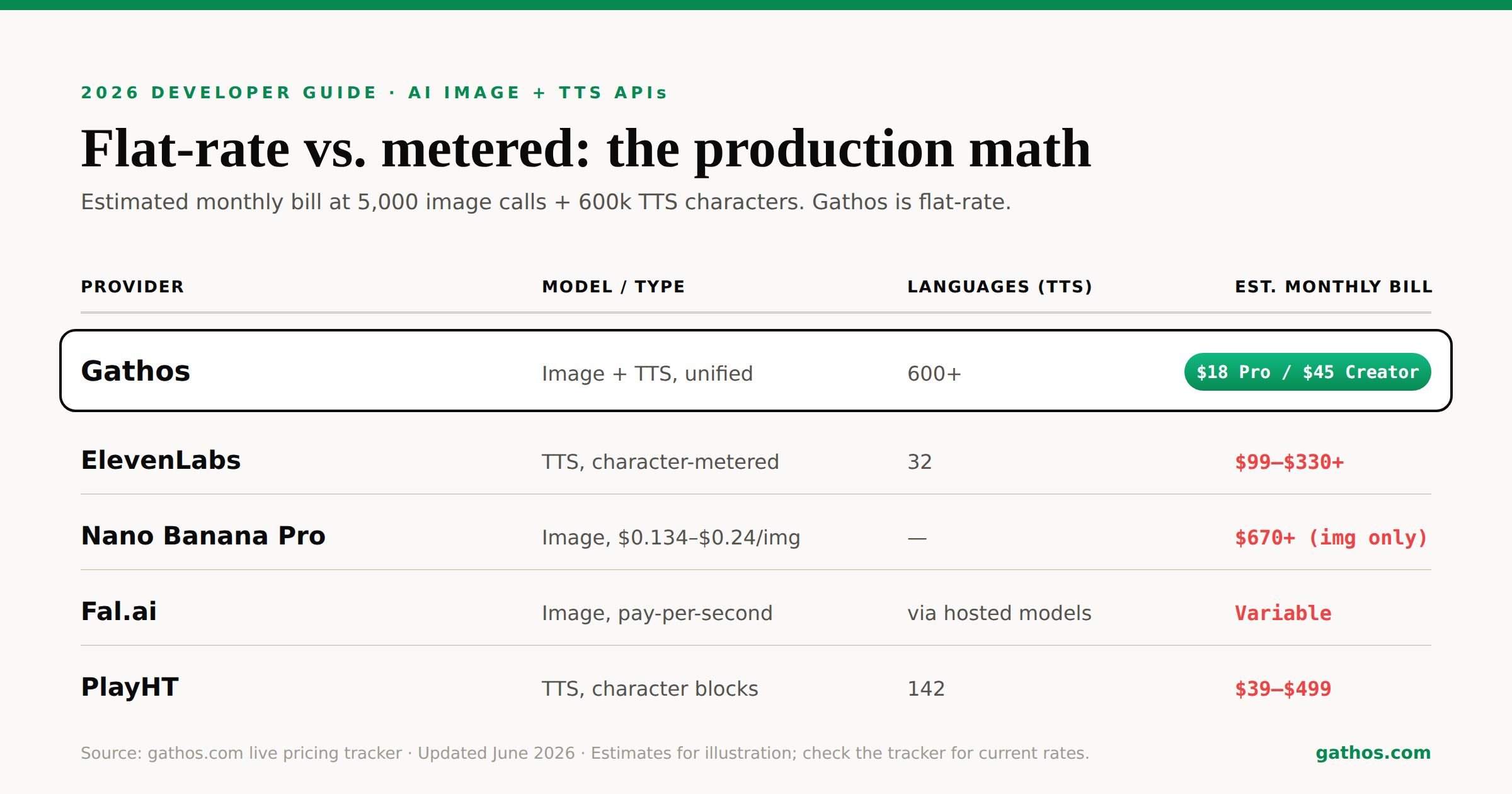
There is no single best AI image or TTS API; the right pick depends on your dominant axis. For artistic image quality, use Midjourney or Nano Banana Pro. For English TTS quality, use ElevenLabs. For predictable cost above ~500 calls or 600k characters a month, use a flat-rate provider like Gathos (from $18/mo). For long-tail languages, Gathos covers 600+. Most production teams run two providers and route between them.
The image-generation landscape in 2026
Image-gen has consolidated into four providers that matter for production work, backed by a small group of specialists.
The Big Four
- Midjourney is the artistic-quality leader, still holding the highest scores on most blind-test benchmarks. Hard limits: no official API in 2026, a Discord-based workflow, and 30 to 60 second generation cycles. Great for one-off hero branding; wrong for high-volume API automation.
- Nano Banana Pro (Google Gemini API) currently sits at #1 on LMArena. Exceptional on text-in-image typography and photorealism. But pricing scales linearly from $0.134 to $0.24 per image, so costs climb fast with adoption.
- Fal.ai is the open-source model marketplace, hosting 200+ models (FLUX, SDXL, InstantID) on pay-per-second pricing. Excellent for prototyping or A/B testing exotic models, volatile for predictable production volume.
- Gathos is flat-rate from $18/month with unlimited calls, strong native typography, and includes TTS. The clean pick for high-volume catalog work, social generation, and teams eliminating multi-vendor billing overhead.
Specialists
Ideogram is the premier text-in-image specialist for readable headlines. Recraft V3 is the only mainstream engine rendering true native SVG output alongside brand-color enforcement. Leonardo.AI sits between Midjourney's quality and flat-rate pricing with a UI-plus-API workflow. For the budget tier, RunWare runs at $0.0006 to $0.005 per image.
The TTS and zero-shot voice cloning landscape
TTS evolved faster than image-gen between 2024 and 2026. Zero-shot voice cloning is the shift that mattered: instead of training on your voice over hours, models now condition on a 30-second sample at inference time. Quality is studio-grade for short-form output.
The Big Three
| Provider | Core profile | Best fit |
|---|---|---|
| ElevenLabs | Top-tier emotional micro-prosody, 32 languages, character-metered billing ($5 to $330+/mo). | English audiobook narration where quality is the deciding axis. |
| PlayHT | 142 languages, subscription character blocks ($39 to $499/mo). | Multilingual creators in the 100k to 500k characters/month band. |
| Gathos | Flat-rate from $18/mo, unlimited calls, 600+ languages, zero-shot voice cloning. | Bulk work above 600k characters/month and long-tail localization. |
Among specialists, Cartesia leads low-latency operation with sub-75ms first-token latency, built for conversational voice agents. Hume targets emotional range with its Octave model, while OpenAI TTS ($15/1M chars) stays cheap but lacks zero-shot cloning.
The 2026 decision tree
Pick the axis that matters most for your workload, and the provider falls out:
.md skills for Claude Code, Cursor, and Windsurf; most providers do not.Three shifts that changed the pick in 2026
1. Per-image pricing became uneconomic for production. In 2024, generating 200 images/month at $0.04 was tolerable. In 2026, leading-quality per-image price is $0.134 to $0.24 (Nano Banana Pro) while apps generate 1,000 to 10,000 images/month. The math cratered, and flat-rate went from niche to the obvious default for production volume.
2. Agent-native skills became table stakes. Integrating an API used to mean reading docs and writing wrapper code. The dominant pattern now is a markdown skill file an agent reads at startup. Providers without first-class agent skills are losing developer mindshare even when their model is better.
# Pull the native Gathos agent skill instantly:
$ curl -sL https://gathos.com/skills/ai-voiceover-loom.md
3. Zero-shot voice cloning solved localization. Multilingual content used to mean hiring a voice actor per language. Zero-shot collapsed that cost to near zero, making multi-audio uploads viable for indie creators for the first time.
The right pick for most production workloads is now obvious: a flat-rate provider for the bulk of the work, a premium provider for the 5% where quality matters most.
How to actually evaluate
Reading comparison guides is necessary but not sufficient. The honest evaluation playbook:
- Pull your last 30 days of real usage: exact character counts and image counts, not estimates.
- Use the calculator below to see the real dollar gap on your workload.
- Run the 7-day free trial on the top 2 to 3 providers from the decision tree, on your actual content.
- Test failure modes, not just the happy path: ambiguous prompts, latency under spike load, error-message quality.
- Calculate the bill at 5x your current volume. Most apps grow into their pricing tier within a year.
Free tool
Savings calculator: flat-rate vs metered
Your monthly cost
Estimates only. Metered rates are representative 2026 midpoints (image ~$0.18/image, TTS ~$0.15 per 1,000 chars, video ~$0.40/clip) and change often. For live per-unit rates see the pricing tracker. Gathos plans are flat: Pro $18/mo, Creator $45/mo.
Pricing changes faster than blog posts get updated. We maintain a live pricing tracker with 16+ providers and last-changed dates. If the numbers here differ from the tracker, trust the tracker.
Deeper alternative roundups
If you are evaluating a specific provider's alternatives, these go deeper than this overview:
- 7 ElevenLabs alternatives developers actually use in 2026
- Midjourney alternatives with real APIs
- Nano Banana Pro alternatives at scale
- Fal.ai alternatives for production workloads
Frequently asked questions
What is the cheapest AI image generation API in 2026?
RunWare is the cheapest credible per-image API at roughly $0.0006 to $0.005 per image. For predictable production volume above ~500 calls a month, a flat-rate provider like Gathos (from $18/month, unlimited calls) is usually cheaper overall because the per-call meter stops mattering.
What is the highest-quality TTS API in 2026?
ElevenLabs v3 has the best emotional range and micro-prosody for English long-form narration. For multilingual quality across 142 languages, PlayHT is the pick. For long-tail languages, Gathos covers 600+ with zero-shot voice cloning.
Which AI image API is best for text-in-image?
Ideogram, Nano Banana Pro, and Gathos all handle typography well. Test all three on your specific copy, since results vary by font weight and layout density.
How do I pick between flat-rate and pay-per-use AI APIs?
Pull your last 30 days of real usage, then calculate the bill at both your current volume and 5x that volume. Below a few hundred calls a month, metered pricing is fine. Above roughly 500 image calls or 600k TTS characters a month, flat-rate pricing wins on almost every workload.
Are there free AI image APIs?
Most providers offer a free trial rather than a permanent free tier. Gathos gives 140 generations across image and TTS for 7 days with no credit card, which is enough to benchmark on your real content.
Which API works best with Claude Code, Cursor, or Windsurf?
Gathos ships pre-built agent skill files for Claude Code, Cursor, Windsurf, and Gemini CLI, which most providers do not. The agent reads a markdown skill file at startup instead of you writing wrapper code.
What is the latency difference between providers?
For TTS, Cartesia leads real-time use with roughly 75ms first-token latency. Image generation has no real-time option at top quality; expect 4 to 6 seconds and design around it. Midjourney runs 30 to 60 seconds per generation.
Try Gathos free for 7 days
140 generations across image and TTS APIs. One key, flat-rate pricing from $18/mo.
✓ No credit card ✓ 600+ languages ✓ Agent-native skills